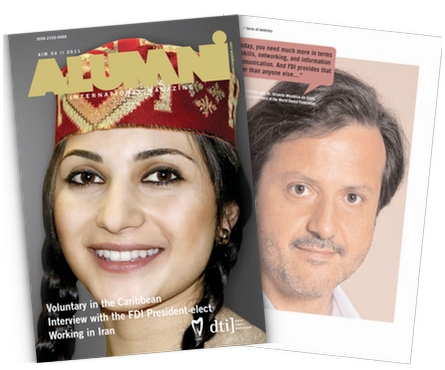
Please check my interview at the ALUMNI International Magazine (PDF), from the Young Dentists Worldwide, as president-elect of the World Dental Federation.
Download PDF (303 KB)
Please check my interview at the ALUMNI International Magazine (PDF), from the Young Dentists Worldwide, as president-elect of the World Dental Federation.
Download PDF (303 KB)
 Comments Off on ALUMNI International Magazine interview |
  FDI World, Interviews |
  Permalink
 Posted by Orlando Monteiro da Silva
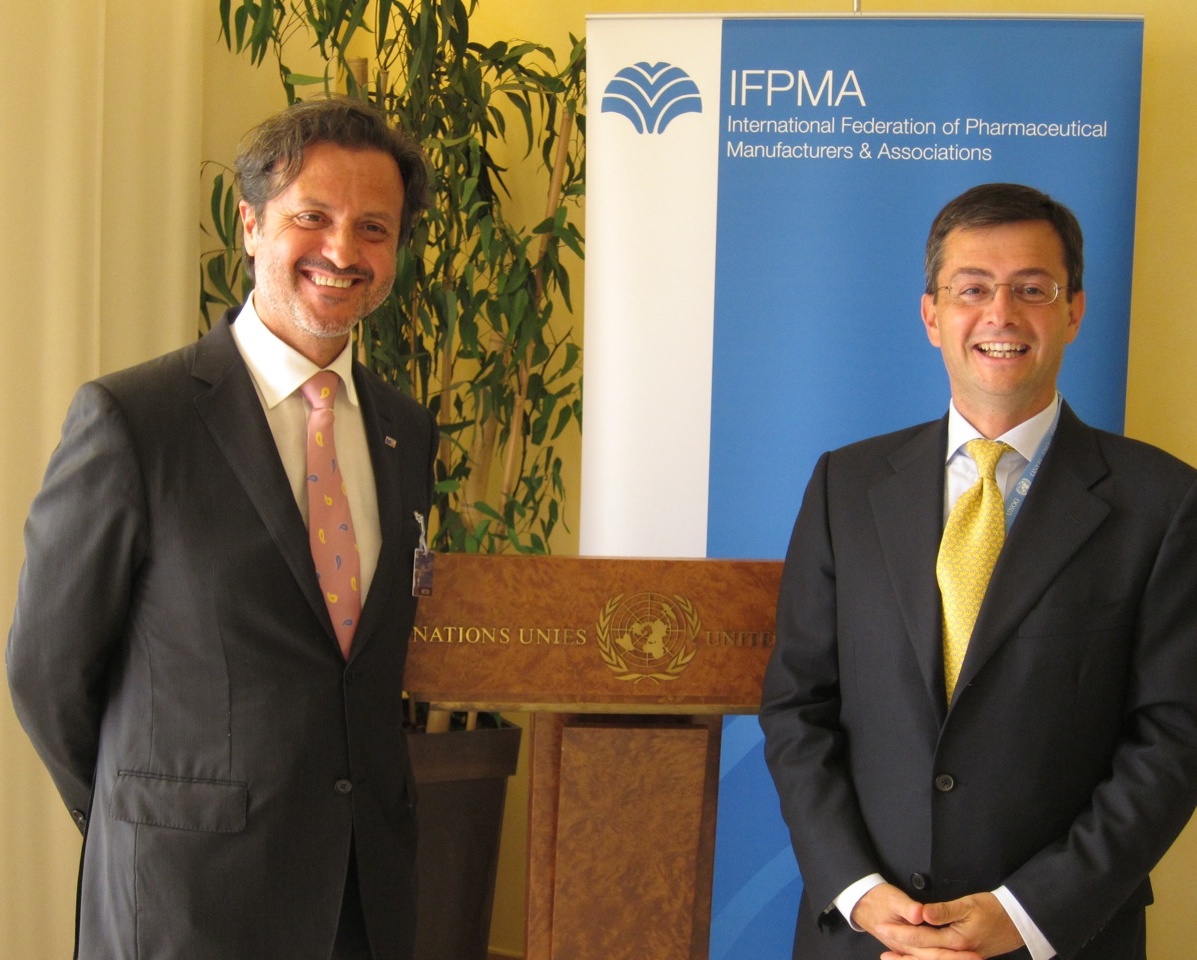
Me with Eduardo Pisani, Director General of IFPMA (International Federation of Pharmaceutical Manufacturers & Associations)
By invitation of the IFPMA – International Federation of Pharmaceutical manufacturers and Associations, I had the pleasure of participating as speaker representing the World Health Professional Alliance (WHPA) at the United Nations – Economic and Social Council, ECOSOC “Innovation Fair”, on 7 July in Geneva. The Fair run parallel to the ECOSOC High-level Segment.
 The theme was Education for Non Communicable Diseases. I’m sharing a part of my communication, provided by FDI – World Dental Federation Head office Geneva, to a selected audience, acknowledging in particular Eduardo Pisani, moderator and Director General of IFPMA.
FDI President-Elect – brief address to ECOSOC – 7 July 2011
Your excellencies
Ladies and gentlemenThank you for inviting me to say a few words on behalf of the World Health Professions Alliance, representing the views of more than 26 million health professionals. These professionals play a significant role in reducing the global NCD burden through health promotion, disease prevention, patient care and rehabilitation.
One theme of this ECOSOC event is ‘Education for All’: we might equally say ‘health for all’. Health education or health literacy, as we call it, is so tightly related to education: whether it’s basic literacy, to read instructions on medications, or the ability to understand and use the information provided by the medical professional.
Health education will play an extremely important role as policy makers and professionals try to grapple with one of today’s major challenges: the global epidemic of noncommunicable diseases, or NCDs, as they are known. What we need is education, education for the professional, to communicate better, listen better, and education for the patient: how to interpret the advice of the health professional.
WHPA is currently involved in a project to develop and deliver some educational and communication tools to convey important messages to members of the general public on the subject.
Although social and environment factors play an important role in NCDs, our own behaviour can have a significant. The educational messages WHPA is developing are based on prevention: don’t smoke, or if you do, give up; limit your consumption of alcohol, eat healthy food, exercise and check your health from time to time with a health professional for danger signal.
These are easy messages, you may think, yet messages that encounter resistance not just from individuals but from the industries that promote and encourage, for example, smoking or unhealthy food. The important point we want to convey is personal responsibility for health through the choices we make and through our own behaviour. This will be a crucial factor in the fight against NCDs.
The other part of the WHPA campaign is to ensure that our views on preventing and managing noncommunicable diseases are heard by the major international institutions and reflected in the various declarations from international gatherings convened to discuss NCDs.
Our next target is the UN Summit convened in New York on 19 September. We have already provided input and we very much hope that our views translate into specific terminology that addresses our concerns in the Summit Declaration. What we recommended was:
- Adopting an holistic approach based on common risk factors;
- That due attention be paid to the social determinants of health;
- To widen the scope of NCDs and associated recommendations to include oral health and mental health
- Investment in the development and education of the healthcare workforce.
We also believe very much in the need to strengthen health care systems through a holistic health care system, with a focus on primary health care and strong link to prevention, specialized treatment and rehabilitation
I would like to close my remarks by quoting a colleague of mine who highlighted education in school as an effective vehicle to address noncommunicable diseases. Education on health in school reaches children at an age when they are still receptive about behaviour change and to acquire lifelong skills to enable them to lead healthy lives.
As a dentist, I would like also the role of oral health in the context of NCDs: the most common disease worldwide is tooth decay. It has large impact on societies, on children, on each an every one of us. Oral health also has significant co-factors with the other major NCDs. So, in educational programmes dedicated to the control and prevention of NCDs, let’s make sure we include oral diseases.
Comments Off on WHPA: Non Communicable Diseases | FDI World, IFPMA, Switzerland, World Health Professional Alliance | Tagged: geneva | Permalink
Posted by Orlando Monteiro da Silva
Last Thursday, June 16th, in New York, at the United Nations, a very important hearing regarding the prevention and control of non-communicable diseases took place.
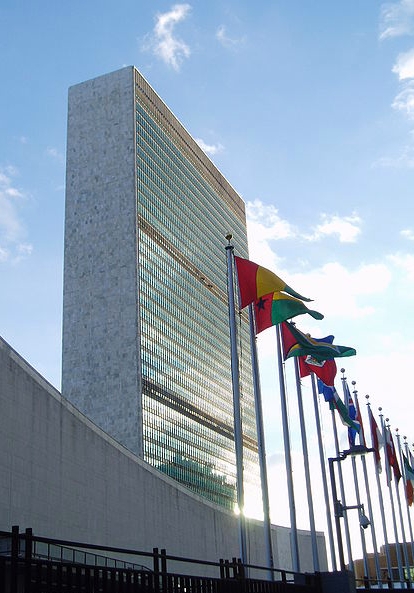
The UN headquarters in New York
This interactive hearing, organized by the President of the General Assembly, Mr. Joseph Deiss, involved non-governmental organizations, civil society organizations, the private sector and academia. All Member States were invited, too. FDI was there taking a strong position on this issue, once more without losing the opportunity to identify steps for a future action plan.
Jean-Luc Eiselé spoke on behalf of WHPA, too.
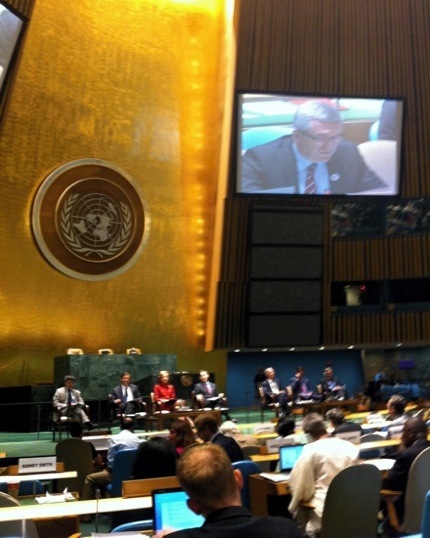
Jean-Luc Eiselé spoke on behalf of WHPA
Non-communicable diseases: cardiovascular disease, cancer, chronic lung diseases and diabetes – kill three in five people worldwide. We could ask why there are no more negotiations and outcomes to prevent this kind of diseases worldwide. Maybe because its own name doesn’t help. Regarding this opinion, I underline the report of HRH Princess Dina Mired (Jordan) at the opening session: diseases denominated non-communicable are undervalued in its impact on public opinion. It’s like if they are not communicable there is no need to communicate it or release it, so it’s not important. We have the idea that only what is communicable it’s important, so we have here an elementary problem in drawing attention. And more than ever, social mobilization efforts are needed.
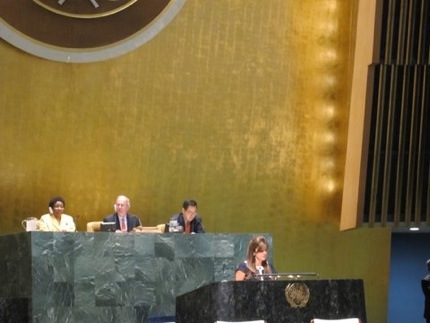
Princess Dina Mired (Jordan) at the opening session
I am deeply concerned with the outcomes of this hearing, which will form the basis for the high-level meeting of the UN General Assembly, next September, where I also hope to be present. Our purpose should be to join several opinion makers in order to bring more inputs to this discussion and create a strong circle for a strong call of attention.

Me, Marion Bergman (Miracle Corners of the World) and Roberto Vianna
It’s our duty, as FDI members, to be aware and to make each government aware of the problem of non-communicable diseases and recommend specific actions for each one. What is being done, and what can be done. How can we communicate what seems to be non-communicable! It will be a marathon to reduce the impact and deaths caused by non-communicable diseases, but a solid start began in NY. And I was there.
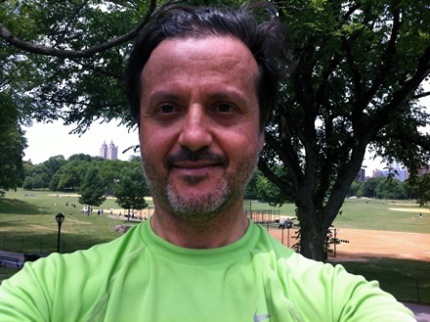
Running at Central Park
(Photo “The UN headquarters in New York” licensed from Steve Cadman/Wikimedia Commons under the Creative Commons Attribution-Share Alike 2.0 Generic)
Comments Off on Non-communicable Diseases: Millions of deaths can be prevented | FDI World, USA | Permalink
Posted by Orlando Monteiro da Silva
Antimicrobial resistance: no action today no cure tomorrow. FDI joins WHO call on Antimicrobial resistance. Read more here.
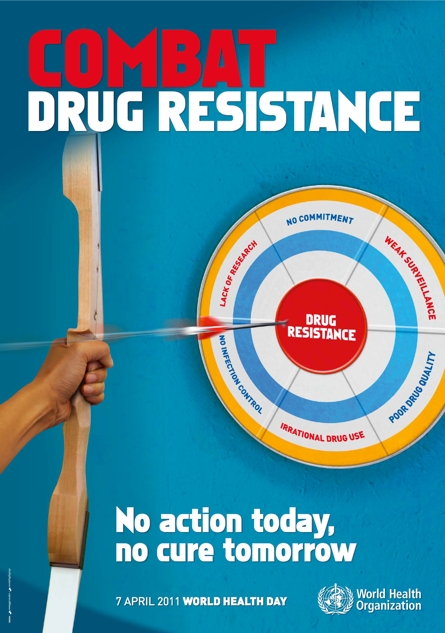
Comments Off on World Health Day – 7 April 2011 | FDI World, World Health Organization | Permalink
Posted by Orlando Monteiro da Silva
Last week, took place the second session of the intergovernmental negotiating committee to prepare a global legally binding instrument on mercury, at the Makuhari Messe Conference Centre in Chiba, Japan.
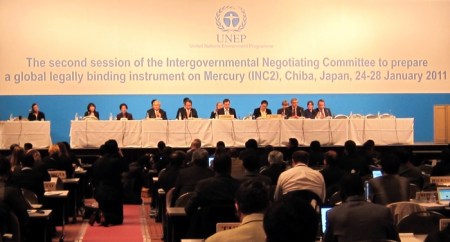
Second session of the Intergovernmental Negotiating Commmittee to prepare a global legally binding instrument on Mercury (INC2), Chiba, Japan, 24-28 January 2011
I was there representing FDI World Dental Federation, leading the delegation. FDI had a substantial representation as well as ADA, IADR, among others organizations. Presences: Dr Julian Fisher, Dr Stuart Johnston, Dr Masaki Kambara, Dr Peter Cooney, Dr Dan Meyer, Dr. Jerome Bowman, Dr. Christopher Fox and Dr. Kenneth Anusavice. I specially acknowledge the role of Dr. Julian Fisher dealing with all the aspects of this important summit.
FDI’s presence was very important to ensure that the issues concerning dental amalgam are properly represented in this discussions regarding mercury.
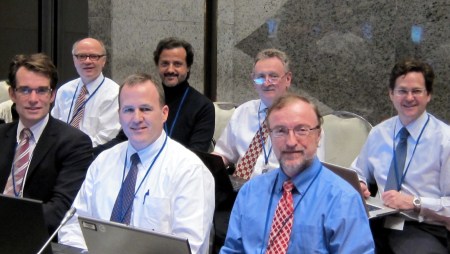
This session was more detailed than the first one on the mercury instrument, bringing positive points and scientific appointments. Several Governments also provided additional information to contribute to the documents for discussion.


Comments Off on United Nations Environment Programme | FDI World, Japan | Permalink
Posted by Orlando Monteiro da Silva
 When, about 10 years ago, I started to attend the meetings of the FDI, I realised that the matters under discussion were essential for the practice of our profession.
Then and now the growing influence of globalisation affected dentistry, both directly and indirectly.
Comments Off on A Reflection about the future of the Dental Profession in FDI | FDI World, Organizations | Permalink
Posted by Orlando Monteiro da Silva
 Orlando Monteiro da Silva